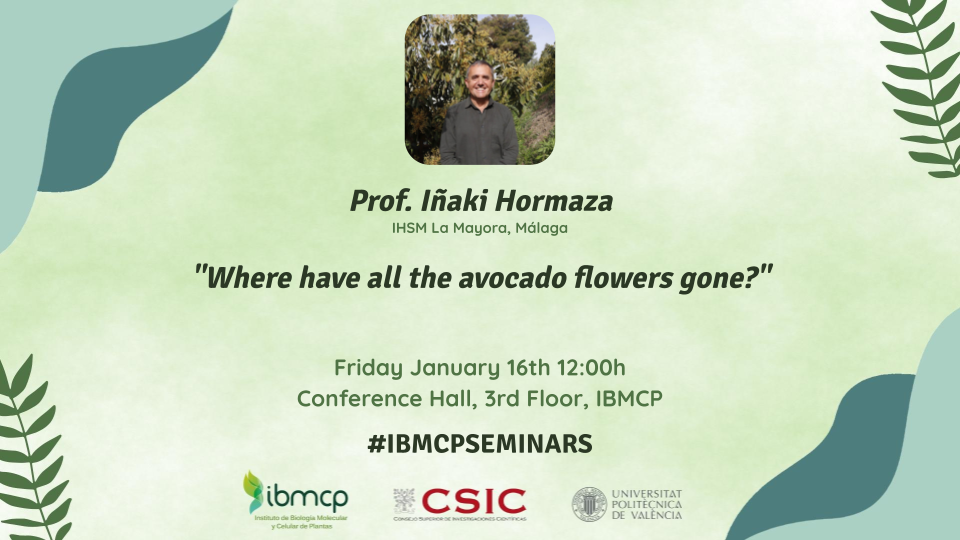
Prof. Iñaki Hormaza
IHSM La Mayora, Málaga
“Where have all the avocado flowers gone?”
The avocado (Persea americana Mill.) is a member of the Lauraceae in the order Laurales that belongs to the Magnoliid clade, considered a sister clade to the eudicot and monocot angiosperms. Despite its economic importance, avocado trees exhibit a notably low fruit-to-flower ratio, with fewer than 0.2% of flowers developing into mature fruits. This phenomenon is driven by a complex interplay of factors that include environmental conditions, flower quality, the need for pollinator trees or inefficient insect pollination. The avocado’s protogynous dichogamy, a flowering pattern where the female phase precedes the male phase, adds another layer of complexity to this issue. During this talk I will discuss how a combination of basic knowledge or reproductive biology and applied field work can provide significant clues at understanding the causes of low fruit yield in avocados in order to optimize productivity. Please find attached 2 recent papers.
Short bio
After obtaining a PhD in Plant Biology at the University of California, Davis in 1994, in 2000 I got a permanent research position at the IHSM la Mayora-CSIC-UMA where, since 2009, I am a Research Professor. During my scientific career, I have been involved in numerous national and international research projects focused in studies of genetic diversity, germplasm characterization and conservation and reproductive biology in subtropical and temperate fruit tree crops. I have coordinated more than 50 national and international research projects and over 60 contracts with the private sector, resulting in more than 200 publications in journals and books (more than 160 of them in SCI journals) and more than 130 invited conferences in different countries. The publications of my group have had significant impact in two major areas of plant biology, reproductive biology and genetic diversity and germplasm conservation. Thus, the works on reproductive biology have contributed to identify the main bottlenecks at the reproductive level that limit fertilization and fruit production in both temperate and tropical fruit crops. In addition, an important part of my scientific career has been devoted to study the in situ and ex situ diversity in several fruit crops with a high impact in understanding their extant diversity as well as the movement and conservation of germplasm. The international activities have had an additional impact in research for development. A high number of the projects have been made in collaboration with colleagues from low and middle income countries with a high impact in utilizing the results of the research performed in my group to improve the living conditions of small scale farmers in different American and African countries.